How to use a coco peat block
Put the block in a tub, add water a little at a time, let it soak until soft, then break it apart and mix it into your pots. One UK seller says a 5 kg block takes about 18 litres of water and about an hour, and the Coir Board's figures put its yield at 65 to 70 litres.
On this page
How much water does a coco peat block need?
A 5 kg block of coir pith, fibre and chips needs about 18 litres of water, by one UK seller's figure. A US listing for one brand's 1.4 lb brick, about 635 g, says it needs 1 to 2 US gallons, or about 3.8 to 7.6 litres. Figures vary by maker, so check the pack first.
Size
- Brick (about 650 g)
- 20 x 10 x 5 cm (Coir Board)
- Block (5 kg)
- 30 x 30 x 13 cm (Coir Board)
Water to add
- Brick (about 650 g)
- 1 to 2 US gallons, about 3.8 to 7.6 litres, for one brand's 1.4 lb brick
- Block (5 kg)
- About 18 litres (one UK seller)
Soak time
- Brick (about 650 g)
- At least 15 minutes for small bricks (a UC Master Gardener); 10 to 15 minutes (one brand)
- Block (5 kg)
- At least 1 hour for big bricks (a UC Master Gardener); around 1 hour (one UK seller)
Loose coco peat
- Brick (about 650 g)
- About 8.7 litres from one brand's 1.4 lb brick
- Block (5 kg)
- 65 to 70 litres, from the Coir Board's 13 to 14 litres per kg; 60 to 80 litres in sellers' claims
| What you need to know | Brick (about 650 g) | Block (5 kg) |
|---|---|---|
| Size | 20 x 10 x 5 cm (Coir Board) | 30 x 30 x 13 cm (Coir Board) |
| Water to add | 1 to 2 US gallons, about 3.8 to 7.6 litres, for one brand's 1.4 lb brick | About 18 litres (one UK seller) |
| Soak time | At least 15 minutes for small bricks (a UC Master Gardener); 10 to 15 minutes (one brand) | At least 1 hour for big bricks (a UC Master Gardener); around 1 hour (one UK seller) |
| Loose coco peat | About 8.7 litres from one brand's 1.4 lb brick | 65 to 70 litres, from the Coir Board's 13 to 14 litres per kg; 60 to 80 litres in sellers' claims |
How do you soak and break up a coco peat brick?
Put it in a tub or wheelbarrow with room to grow, add water and wait. A UC Master Gardener in Solano County, California, says to soak small bricks for at least 15 minutes and big bricks for at least an hour. Break it apart as it softens, and add water to any dry patches.
- 1.Pick a container with room to spare. The same gardener suggests a wheelbarrow for a big brick, since it grows as it soaks.
- 2.Pour the water in a little at a time, as one UK seller advises for its 5 kg block, and break it apart as it expands.
Warm or cold water? Iowa State University Extension, writing about the coir disc in some amaryllis bulb kits, says to rehydrate it with warm water, then wait for it to expand and loosen. The brick and block instructions quoted in this post ask only for water and name no temperature.
Do you need to rinse coco peat after soaking?
Rinse it if it may be salty. Coir carries natural salts, measured as EC, which the RHS says can affect how plants take up nutrients. The Coir Board's 2016 block specification sets EC under 0.5 mS/cm. The Solano gardener notes that some people recommend flushing the salts out before starting seeds.
Sources differ on how often this matters. A 2018 Washington State University Extension leaflet says current processing prevents the salt problem. Oklahoma State University, in 2021, says salinity could be a problem if husks are soaked in salt water and not rinsed with fresh water, and that coir must be washed.
A coir compost maker quoted by the RHS says carnivorous plants may suffer unless coir is adequately washed to remove salts.
How do you mix coco peat for pots and seed trays?
The Solano gardener says coco peat usually goes into a soil mix, since pith holds so much water that a plant could get too much if it is used alone. Oklahoma State says coir can also be used alone, for vegetables and cut flowers. Either way, plan to feed the plants.
- Pots and grow bags: our post on coco peat or soil gives mix ratios from the RHS and agricultural universities.
- Feeding pots: one UK seller recommends adding fertiliser after 3 to 6 months in its coir.
- Seed trays: the RHS, writing about peat-free seed compost, says it should be moist but not soggy before you sow. Saturated compost is colder, which can slow germination.
- Feeding seedlings: the Solano gardener says some fertiliser needs adding when you set up seed starts in coir. The RHS, writing about peat-free seed compost, says to start feeding at the first true leaves, later than the Solano gardener.
Why is my coco peat block not expanding?
Check the water and the time first. One UK seller says a 5 kg block needs about 18 litres, added gradually, and expands within around an hour. The Solano gardener says to soak big bricks for at least an hour. Break it apart as it softens and add water to any dry patches.
Expect a lot of growth, but not a set amount. Oklahoma State says a briquette expands up to 6 times its size as it soaks. It also says coir products vary widely, because sources and production methods differ. Sellers' claims for a 5 kg block run from about 60 to 80 litres, so judge yours against its own pack.
Questions people ask
Can you cut a coco peat brick in half?
A UC Master Gardener in Solano County says not to even consider it, because the brick will win. Soak the whole brick instead, in a container with room for it to grow. If you need only a little coco peat, buy the smaller 650 g brick rather than a 5 kg block.
How many pots will a 5 kg coco peat block fill?
It depends on the pot and the mix. By the Coir Board's figures, a 5 kg block gives 65 to 70 litres. As an example, that fills 6 or 7 pots that hold 10 litres each with coco peat alone. If coco peat is half of each pot's mix, it fills 13 or 14.
What is the difference between coco coir chips and a brick?
A UC Master Gardener in Solano County says chips, or chunks, hold water while leaving air pockets, so they suit container plants and gardens. Bricks, the gardener says, hold 5 to 7 times their weight in water once rehydrated, and are used for seed starts and as an addition to container soil.
What if soaked coco peat dries out?
Water it again. A UC Master Gardener in Solano County says coir is easier to rehydrate than peat moss that has dried out. A 2018 Washington State University Extension leaflet calls coir non-hydrophobic, meaning it does not repel water. The same leaflet says dry peat moss is very hard to rewet.
Where can I buy a coco peat brick or block?
Keraline Exports sells coco peat from Kerala coconut husk as a 650 g brick for ₹139 or a 5 kg block for ₹299, at October 2026 prices. Either one goes by courier anywhere in India, and you pay only after the team confirms the price on WhatsApp. For bigger needs, it quotes blocks by the pallet or the container.
Need a brick or a block?
Our coco peat comes from Kerala coconut husk, as a 650 g brick for ₹139 or a 5 kg block for ₹299. We send it by courier anywhere in India, and you pay only after we confirm the price on WhatsApp.
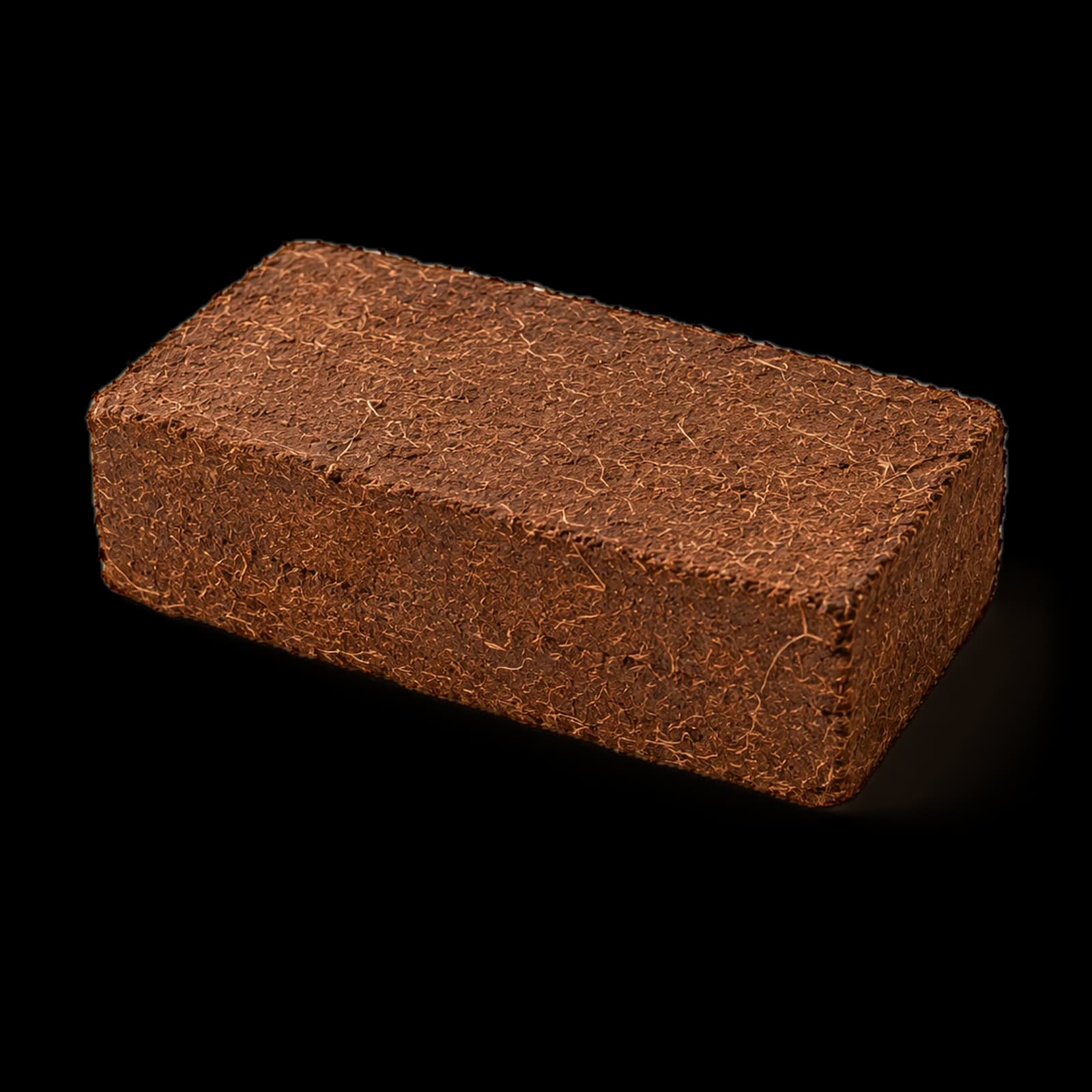 Coco Peat650 g brick ₹139 · 5 kg block ₹299
More from the blog
Sources
- Coir Board: Coir pith, wealth from waste, 2016 (archived copy)
- UC ANR, Under the Solano Sun (UC Master Gardeners of Solano County): Coir, 2022
- Oklahoma State University Extension: Soilless growing mediums (HLA-6728), 2021
- Iowa State University Extension: All about amaryllis
- RHS: How sustainable is coir? (coir questions answered)
- RHS: A guide to compost mixes for houseplants
- RHS: Using peat-free compost for seeds and cuttings
- Washington State University Extension, Kittitas County: Coconut coir vs peat moss, 2018
- Gardening Naturally: 5 kg coir block (seller's figures)
- Green Gardener: Coir compost block 5 kg (seller's figures)
- Trimleaf: Vivosun 1.4 lb coco coir brick (the brand's figures on a US retailer page)