What is coconut shell used for?
ICAR-CPCRI scientists call charcoal the most important product made from coconut shell: it is burnt as fuel and turned into activated carbon. Coconut shell is also ground into powder for glues, resins and mosquito coils, used to fuel copra dryers, and carved into bowls, cups, spoons and buttons.
On this page
What are the uses of coconut shell?
ICAR-CPCRI scientists name 3 commercial products made from coconut shell: shell charcoal, activated carbon and shell flour, also called shell powder. The shell is also burnt as fuel, for example to dry copra. Artisans make it into bowls, cups, spoons, ladles and buttons. The table shows what each use makes and who buys it.
Charcoal
- What is made
- Shell charcoal, in pieces or granules
- Who buys it
- Activated carbon makers, and cooks who grill
Activated carbon
- What is made
- Powdered and granular carbon
- Who buys it
- Vegetable oil and sugar processing, medicines, water treatment, respirators
Shell powder
- What is made
- Fine powder, sieved to size
- Who buys it
- Makers of resin glues, phenolic moulding powders and mosquito coils
Fuel
- What is made
- Heat for drying copra, also tested in boilers
- Who buys it
- Copra makers with shell fired dryers
Crafts
- What is made
- Bowls, cups, spoons, ladles, buttons, jewellery
- Who buys it
- Local and export buyers, the ICC says of Thai shell crafts
| Use | What is made | Who buys it |
|---|---|---|
| Charcoal | Shell charcoal, in pieces or granules | Activated carbon makers, and cooks who grill |
| Activated carbon | Powdered and granular carbon | Vegetable oil and sugar processing, medicines, water treatment, respirators |
| Shell powder | Fine powder, sieved to size | Makers of resin glues, phenolic moulding powders and mosquito coils |
| Fuel | Heat for drying copra, also tested in boilers | Copra makers with shell fired dryers |
| Crafts | Bowls, cups, spoons, ladles, buttons, jewellery | Local and export buyers, the ICC says of Thai shell crafts |
What is coconut shell made of?
Coconut shell is the hard, protective layer under the husk. ICAR-CPCRI scientists put it at about 12% of the nut, against 35% for the husk. Ground into powder, the shell is mostly cellulose, lignin and hemicellulose, with small amounts of minerals and protein, the Coconut Development Board says.
The share of each varies from study to study. A 2011 University of Kentucky study measured 44% lignin and 29.7% cellulose in dry coconut shell. That was the highest lignin content of all the materials it tested. Other studies it cites put lignin in coconut shell anywhere from 27.2% to 50%.
In ICAR-CPCRI figures for making virgin coconut oil, 500 nuts give about 67 kg of shell, next to about 200 kg of husk.
What is coconut shell charcoal used for?
Coconut shell charcoal is used as fuel for cooking and grilling, and it is the raw material for activated carbon. The Coconut Development Board also lists air and water purification, cosmetics, pharmaceuticals, farming and industry. ICAR-CPCRI scientists call charcoal the most important product made from coconut shell.
The Board describes heating dried shells without oxygen, typically at 600°C to 900°C in a kiln or a retort. ICAR-CPCRI scientists describe burning dried, mature shells with a limited supply of oxygen, and name the drum and pit methods as the most widespread. The Board recognises 2 types: pieces and granulated.
Shell charcoal is the raw material for activated carbon, and ICAR-CPCRI scientists write that about 3 tonnes of it make 1 tonne. The charcoal is reacted with steam at 900°C to 1100°C in a rotary kiln, the Board explains. Powdered grades are used to decolour vegetable oils and sugar solutions. Granular grades go into water purification, solvent recovery and respirators.
What is coconut shell powder used for?
Coconut shell powder goes into glues, resins and mosquito coils. ICAR-CPCRI scientists list it as a filler in synthetic resin glues, a filler and extender in phenolic moulding powders, and a burning medium in mosquito coils. It is also used in mastic adhesives, resin casting and bituminous products.
To make it, cleaned shells are broken up, ground fine in a pulveriser and sieved, the Coconut Development Board explains. How fine it is ground depends on the end use. ICAR-CPCRI scientists call shell flour a second important product from the shell, after charcoal.
Researchers are also mixing shell powder into polymers to make composite materials, a review first published in 2020 reports. It notes the shell is low in cost and weight, which can cut production costs.
Can coconut shell be used as fuel?
Yes. Coconut shell can fuel a copra dryer, such as one ICAR-CPCRI designed, and has been tested as a boiler fuel. A 2011 University of Kentucky study measured 19.8 MJ of heat per kg of dry coconut shell. That sits inside the range the study gives for high rank coal, 18 to 25.5 MJ per kg.
CPCRI designed a copra dryer that burns coconut shell, a Kerala Agricultural University page explains. It takes 1,000 to 1,200 nuts a batch. Each fuel tray holds 80 shells and gives heat for about 6 hours. About 4 loads dry the copra to about 6.25% moisture in 24 hours.
For boilers, researchers at IPB University in Indonesia ran a test boiler on coconut shell in a 2023 study. Its thermal efficiency peaked at about 62%, and they concluded that coconut shell is suitable as boiler fuel.
What can you make from coconut shell?
You can make bowls, cups, spoons, ladles, buttons and jewellery from coconut shell. In Kerala, artisans turn shells into bowls, cups, spoons and decorative pieces, Kerala Tourism says. The International Coconut Community lists more shell crafts made in Thailand, including ladles, buttons, trays, lamp shades, necklaces, earrings and key rings.
Thick, fine shells that are round or globular suit craft work, the same ICC page says. Thai makers cut, trim and polish the shell, then draw and set the design, and fit ladles and spoons with wood or coconut wood handles. Thai shell crafts sell at home and in export markets such as the United States, Japan and Germany.
Questions people ask
What is coconut shell called?
Scientists call coconut shell the endocarp. A 2011 University of Kentucky study describes it as the hardened endocarp of the coconut. It groups coconut shell with peach stones, olive stones and walnut shells as drupe endocarp. Of all the materials that study tested, coconut shell had the most lignin, at 44%.
How many coconut shells make 1 kg of charcoal?
About 17 to 24 whole shells. ICAR-CPCRI scientists write that 17,000 to 24,000 whole shells make 1 tonne of charcoal. They put the yield of charcoal at about 30% of the weight of the shells. So 1 kg of charcoal takes roughly 3.3 kg of shell.
Does coconut shell charcoal burn longer than wood charcoal?
The Coconut Development Board says coconut shell charcoal burns longer than some other charcoals, such as wood charcoal. It says it gives less smoke and little smell. ICAR-CPCRI scientists call it one of the best fuels for cooking because of its pleasant smell. Neither source gives test figures for burning time.
What happens to coconut shells that are thrown away?
Coconut shell is usually disposed of by open burning, a review of shell powder composites, first published in 2020, says. The authors note that open burning gives off toxic gases that can harm health and the environment. Turning shells into charcoal, powder, fuel or crafts puts that waste to use instead.
Where can I buy coconut shells?
Keraline Exports sells cleaned, unpolished coconut shell halves from Malappuram in packs of 10 or 30. It also sells coconut shell bowls in pairs. Both go by courier anywhere in India, and you pay only after the team confirms the price on WhatsApp. For coconut shell or shell charcoal by the truck or the container, send a bulk enquiry.
Need coconut shells?
We sell cleaned, unpolished coconut shell halves from Malappuram in packs of 10 or 30, and shell bowls in pairs. They go by courier anywhere in India, and you pay only after we confirm the price on WhatsApp.
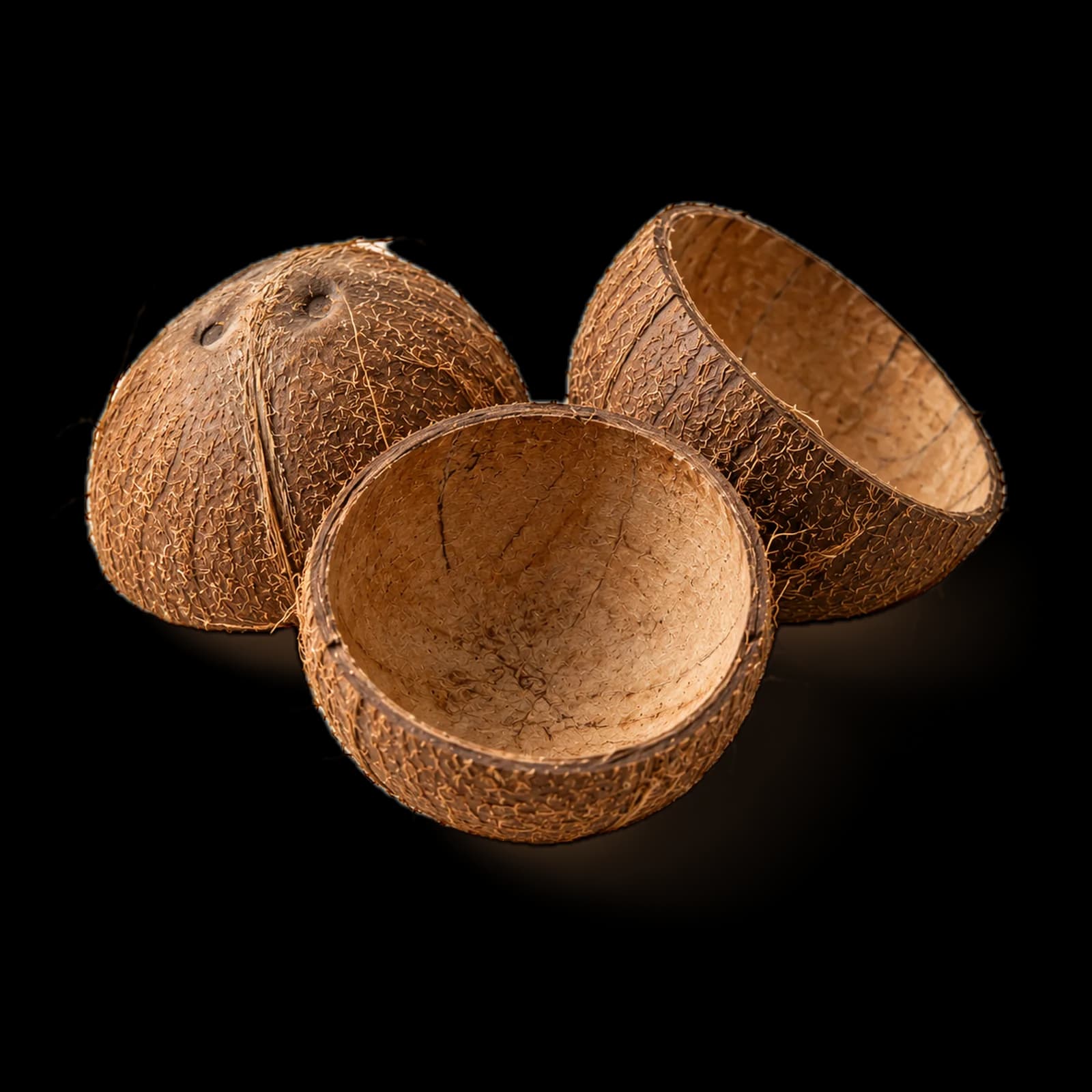 Coconut Shell Halves10 halves ₹299 · 30 halves ₹799
More from the blog
Sources
- Coconut Development Board: Coconut products (revised September 2023)
- Manikantan et al., ICAR-CPCRI (2022), Avenues of value addition in coconut, arecanut and cocoa, Indian Horticulture 67(6)
- Kerala Agricultural University, Centre for E-Learning: Coconut harvest and storage (CPCRI shell fired copra dryer)
- Mendu et al. (2011), Identification and thermochemical analysis of high-lignin feedstocks for biofuel and biochemical production, Biotechnology for Biofuels 4:43
- Yulianto et al. (2023), Thermal characteristics of coconut shells as boiler fuel, International Journal of Renewable Energy Development 12(2)
- Nadzri et al. (2022), A comprehensive review of coconut shell powder composites, Journal of Thermoplastic Composite Materials 35(12)
- Kerala Tourism: Traditional handicrafts of Kerala
- International Coconut Community: Manufacture of coconut handicrafts in Thailand