What is coconut husk used for?
Coconut husk is used to make coir fibre for rope, doormats, brushes, mattresses and geotextiles, and its spongy pith is sold as coco peat for growing plants. Chopped husk is also used as chips for orchids and potting mixes, and some husk is burnt as fuel.
On this page
What is coconut husk made of?
Coconut husk is the thick, fibrous layer between a coconut's outer skin and its hard shell. It is made of long coir fibres set in a light, spongy material called coir pith. The Coir Board puts the fibre at only 20% to 30% of the husk. Most of the rest is pith.
The husk makes up about 35% of a coconut's weight, a 2023 review in the journal BioResources reports. Green coconuts, picked at about 6 to 12 months, give white fibre, which is smoother and finer. Fully mature coconuts give brown fibre.
What is coir fibre used for?
Brown coir goes into brushes, doormats, mattresses and sacking, and the main use of white coir is rope, the Coir Board says. Mats are woven from the finer grades of fibre on hand or machine looms. Needle-felted pads of curled brown fibre fill mattresses and control erosion on river banks and hillsides.
Bonded with rubber latex, the same pads become rubberised coir for upholstery. Coir also goes into insulation and packaging. Coarse brown yarn goes into geotextiles, an outlet the Coir Board says is growing.
What is coco peat used for?
Coco peat is coir pith, the spongy material left once the fibre is taken out of the husk. Growers use it in place of peat moss to grow plants. The Coir Board says pith was once a waste problem, and it is now India's biggest coir export.
In the year to March 2025, India shipped 821,264 tonnes of coir pith, Coir Board figures show. That was 61% of all coir exports by weight and 60% by value.
India's coir exports in the year to March 2025, in thousand tonnes
How do you use coconut husk chips for plants?
Use them for plants that like a loose medium, such as orchids and anthuriums. Husk chips are small chopped pieces of husk. Kerala Agricultural University recommends dried or old chopped husk for both, used alone for orchids and mixed with brick pieces and charcoal for anthuriums.
- 1.Choose dry chips. The university notes that well-dried husks are better than fresh ones.
- 2.For orchids, fill a clay pot 10 to 20 cm wide with chips. It should have several large holes in the sides and bottom. A slotted wooden basket of small dried pieces also works.
- 3.Plant the orchid on top of the chips, with a support to hold it firm.
- 4.For anthuriums, mix 3 cm pieces of old husk with brick pieces and charcoal. An ideal pot is 30 cm across the top, with 3 large holes at the bottom of the sides.
- 5.Feed anthuriums once a week. The university suggests a 19:19:19 water-soluble fertiliser at 2 g per litre.
How is coir extracted from coconut husk?
The traditional way is retting: husks soak in water for months while microbes loosen the fibre, which is then beaten out by hand. The faster way is mechanical defibering. Husks soak for only 5 days, then a breaker crushes them and revolving drums separate the long fibre from the pith.
Retting takes 3 to 6 months in brackish ponds and close to a year in backwaters and lagoons, by the Coir Board's account. It gives the best white fibre for spinning and weaving. Researchers at the board's Central Coir Research Institute have used microbial enzymes to cut retting to 3 to 5 days.
Beating by hand with wooden mallets has largely been replaced by motorised steel drums with beater arms, a 2023 review notes. The long fibre is then washed, dried and combed, and the pith that falls away becomes coco peat.
Which country produces the most coir?
India produces the most coir. The UN Food and Agriculture Organization put world output at about 1.26 million tonnes in 2019, and India made 518,000 tonnes of it, a 2023 review reports. In India, white coir comes mainly from the coastal region of Kerala, the Coir Board says.
In the year to March 2025, India exported 1,342,843 tonnes of coir and coir products, worth ₹4,343 crore, Coir Board figures show.
Plenty of husk still goes unused. In July 2025, India's Minister of State for Micro, Small and Medium Enterprises said only 30% of the coconut husk generated in India is used effectively. Worldwide, some husk is burnt or made into charcoal, but large amounts are dumped as waste, the 2023 review notes.
Questions people ask
What is the difference between coir and coco peat?
Both come from the coconut husk. Coir is the long, tough fibre used for rope, mats, brushes and mattresses. Coco peat, also called coir pith, is the spongy material the fibres sit in. It separates out when the fibre is extracted and is used in place of peat moss for growing plants.
Is coconut husk good for plants?
Coconut husk is good for plants in several forms. Kerala Agricultural University recommends dried, chopped husk for orchids and anthuriums. Coco peat from the husk is used in place of peat moss. The Coir Board notes that in most coconut areas, husks are left on the fields as mulch or used as fertiliser for their potash.
Can you burn coconut husk as fuel?
Yes, some husk is burnt as fuel or made into charcoal, a 2023 review on coir notes. Large amounts are still dumped as waste. The same review says coir has a high heating value, which makes it a good raw material for fuel pellets and briquettes. These could replace firewood for cooking and heating.
Is coconut husk biodegradable?
It breaks down, but slowly. A 2023 review on coir says heaps of discarded husk take several years to break down because the material resists decay. Coir pith dumped in nature can take decades, because its high lignin and cellulose content makes it slow to degrade.
Where can I buy coconut husk chips?
Keraline Exports sells coconut husk chips from Kerala in a 1 kg bag, sent by courier anywhere in India. It also sells coco peat as a 650 g brick or a 5 kg block. For husk, coir pith or coco peat by the truck or the container, in India or for export, send a bulk enquiry.
Want husk chips for your plants?
We sell coconut husk chips from Kerala in a 1 kg bag, sent by courier anywhere in India. For a finer mix, we also sell coco peat as a 650 g brick or a 5 kg block.
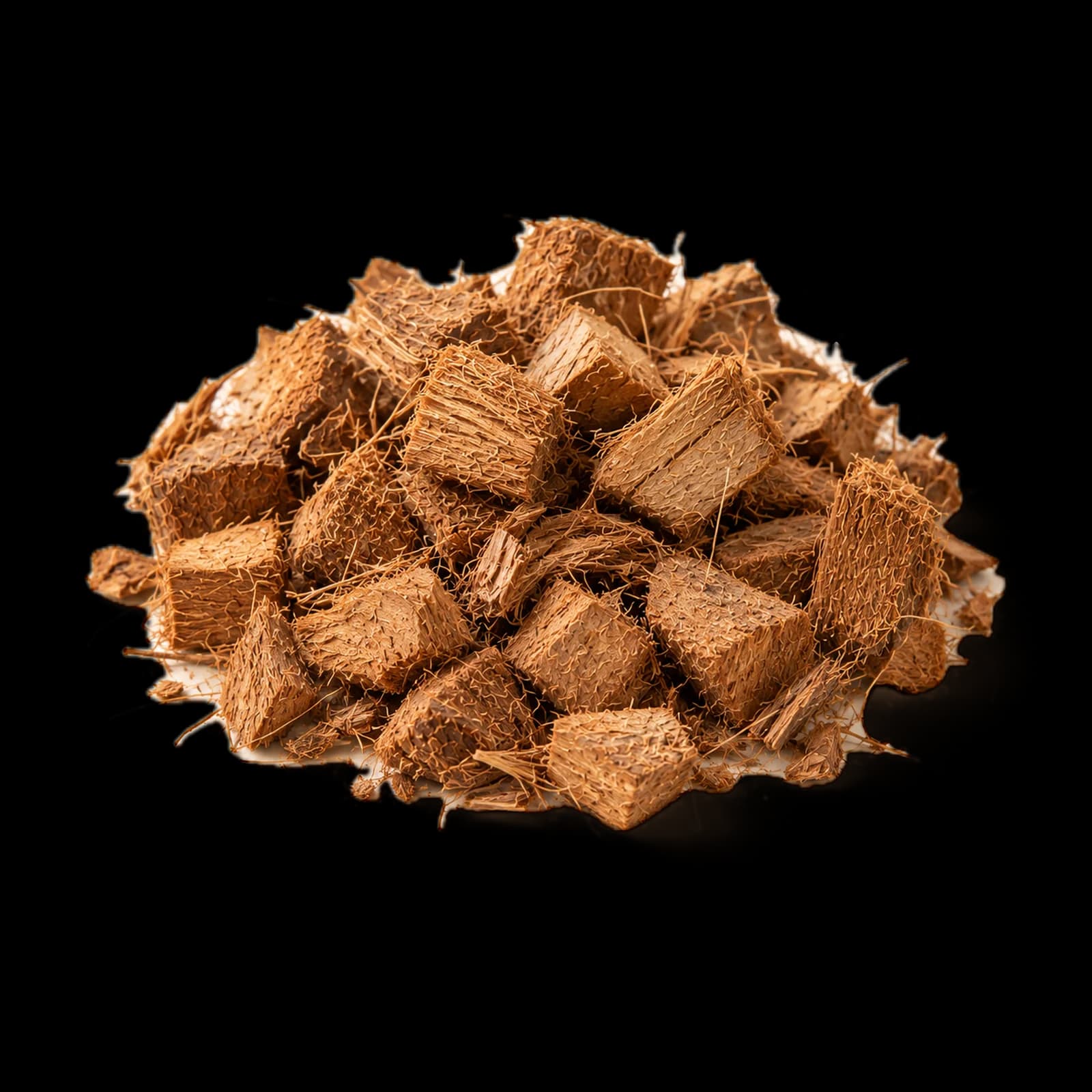 Coconut Husk Chips1 kg ₹149
More from the blog
Sources
- Coir Board of India: Coir fibre (archived copy)
- Coir Board of India: Coir processing, technology and machinery (archived copy)
- Coir Board of India: Composition of coir exports, 2024-25 (archived copy)
- Kerala Agricultural University: Package of practices, ornamental plants
- Stelte et al. (2023), Coir from coconut processing waste as a raw material for applications beyond traditional uses, BioResources 18(1)
- Press Information Bureau: Coir and by-products production need to be scaled up (10 July 2025)