Milling copra vs edible copra
Milling copra is dried coconut kernel made for pressing into oil, and its grades allow far more mouldy kernels, chips and foreign matter than edible copra. Edible copra comes as whole balls or cup-shaped halves and is graded as food, with AGMARK capping ball copra at 7% moisture and 2% mouldy kernels.
On this page
What is the difference between milling copra and edible copra?
Both are copra, the dried kernel of the coconut. Milling copra is pressed for coconut oil, and the cake left over goes mostly to livestock feed. Edible copra is eaten as a dry fruit and used for religious purposes. It is made in 2 forms, ball copra and cup copra.
Ball copra is a whole kernel taken out of the nut in one round piece. Cup copra is a kernel cut into 2 roughly equal halves, each shaped like a cup. Kerala and Tamil Nadu are major producers of milling copra, and ball copra comes mainly from Karnataka.
How are milling copra and ball copra made?
Milling copra comes from split, mature nuts. The kernel is dried in the sun for about 8 days, or for 1 to 4 days in a dryer. Ball copra takes far longer. Whole nuts are stored for 10 to 12 months, until the kernel dries and comes loose from the shell.
Milling copra
The kernel is dried either in its half shell or after it is taken out. The aim is 5 to 6% moisture. In the sun, dust settling on the wet kernel lowers its quality, and so does cloudy, cool weather. Kiln, solar and electric dryers give good copra in less time.
Ball and cup copra
Nuts for ball copra stay on the palm until they are completely ripe and dry. They are then stored whole while the kernel dries and hardens inside the shell. Under AGMARK grading, both ball and cup copra must be well dried and reasonably firm.
What are the grade specifications for copra?
India's AGMARK rules grade edible ball and cup copra. Ball copra may hold up to 7% moisture and cup copra up to 6%, with at most 2% mouldy or black kernels in either. Tamil Nadu Agricultural University (TNAU) lists milling copra limits of 6% moisture and 10% mouldy or black kernels.
Moisture, % by weight
- Milling copra
- 6
- Ball copra
- 7
- Cup copra
- 6
Foreign matter, % by weight
- Milling copra
- 1
- Ball copra
- 0.2
- Cup copra
- 0.5
Mouldy and black kernels, % by count
- Milling copra
- 10
- Ball copra
- 2
- Cup copra
- 2
Wrinkled kernels, % by count
- Milling copra
- 10
- Ball copra
- 10
- Cup copra
- 10
Chips, % by weight
- Milling copra
- 10
- Ball copra
- 1
- Cup copra
- 1
Minimum diameter
- Milling copra
- Not listed
- Ball copra
- 85, 75 or 60 mm by grade
- Cup copra
- 70 mm for Grade 1
Acid value of extracted oil
- Milling copra
- Not listed
- Ball copra
- Not listed
- Cup copra
- 2
Kernel colour and taste
- Milling copra
- Not listed
- Ball copra
- Pearly white to ash white, sweet
- Cup copra
- Pearly white to ash white, sweet
| Test | Milling copra | Ball copra | Cup copra |
|---|---|---|---|
| Moisture, % by weight | 6 | 7 | 6 |
| Foreign matter, % by weight | 1 | 0.2 | 0.5 |
| Mouldy and black kernels, % by count | 10 | 2 | 2 |
| Wrinkled kernels, % by count | 10 | 10 | 10 |
| Chips, % by weight | 10 | 1 | 1 |
| Minimum diameter | Not listed | 85, 75 or 60 mm by grade | 70 mm for Grade 1 |
| Acid value of extracted oil | Not listed | Not listed | 2 |
| Kernel colour and taste | Not listed | Pearly white to ash white, sweet | Pearly white to ash white, sweet |
AGMARK counts a kernel as mouldy or black when more than 5% of its inner surface has mould or is dark brown to black. Foreign matter includes sand, dust, straw and shell. Edible copra must also be free from rancid taste and bad smell.
The same TNAU page gives a second, different set of limits for milling copra: 10% moisture, 2% foreign matter and 5% black copra. Agree the limits in writing before you buy.
Oil and free fatty acids
The International Coconut Community's copra standard sets these limits. Its Grade A, superior edible copra, needs at least 60% oil and no more than 1% free fatty acids. The kernel must be clean and white to pale yellow. Grade B, for export, allows 4% free fatty acids, and Grade C allows 5%.
Why is ball copra more expensive than milling copra?
Ball copra ties up whole nuts for 10 to 12 months and is graded as food. TNAU says it is of superfine quality and commands a premium price. The 2026 minimum support price (MSP), announced on 12 December 2025, is ₹12,500 a quintal for ball copra and ₹12,027 for milling copra.
Both prices are for fair average quality copra. A quintal is 100 kg, so they work out to about ₹125 and ₹120 a kilo. NAFED and NCCF are the central agencies that buy copra at the MSP, under the Price Support Scheme.
Market prices can sit far above the MSP. On 28 October 2026, the Coconut Development Board listed milling copra at ₹15,400 to ₹16,100 a quintal in Kangayam, Kozhikode and Kochi. Ball copra was ₹23,000 in Kozhikode and ₹31,500 in Tiptur. The market gap between the 2 types dwarfs the ₹473 between their support prices. Market prices of milling copra were below the MSP in 2012 and 2016, says the Commission for Agricultural Costs and Prices. Check the board's latest prices before you agree a deal.
How do you check copra quality before buying?
Ask for the grade and test a sample from the lot. Check moisture first, then break kernels open to look for mould and colour. Edible copra should taste sweet, never rancid. For milling copra, ask for a lab test of oil and free fatty acids, since copra quality is linked to oil quality.
- 1.Moisture: AGMARK allows 6% for cup copra and 7% for ball copra, and TNAU's table allows 6% for milling copra.
- 2.Mould: edible grades allow 2% mouldy or black kernels by count, and TNAU's milling copra table allows 10%.
- 3.Colour and smell: edible copra should be pearly white to ash white inside, with no bad smell.
- 4.Lab tests: the International Coconut Community standard measures moisture by gravimetry, oil by Soxhlet extraction and free fatty acids by titration.
Questions buyers ask
What is the MSP for copra in 2026?
The 2026 MSP is ₹12,027 a quintal for fair average quality milling copra and ₹12,500 for ball copra. The government announced both on 12 December 2025, up ₹445 and ₹400 on the 2025 season. NAFED and NCCF are the agencies that buy copra at these prices, under the Price Support Scheme.
How long does it take to make ball copra?
It takes about 10 to 12 months. Nuts for ball copra stay on the palm until completely ripe and dry. They are then stored whole until the kernel comes loose from the shell. Milling copra is far quicker: about 8 days of sun drying, or 1 to 4 days in a dryer.
How much oil does copra contain?
Copra holds 65 to 72% oil, according to the Coconut Development Board's oil mill profile. Its products page gives 65 to 68% fat. A mill does not press out all of it: in that profile, 5 tonnes of copra gives 3 tonnes of oil, and the cake left over sells as cattle feed.
How should copra be stored?
Keep it dry and bagged, never in heaps. Tamil Nadu Agricultural University says copra keeps up to 6 months in polythene tar-coated gunny bags. For storage beyond 3 months, dry it to 4% moisture. Insect pests can cause more than 15% loss after 6 months in store.
Where can I buy milling or edible copra?
Keraline Exports sells dry coconut halves for the kitchen, in 500 g and 1 kg packs sent by courier anywhere in India. Mills and traders can buy milling or edible copra from Keraline by the truck or the container. Send the grade and quantity through the bulk enquiry page for a quote.
Buying copra?
We sell dry coconut halves for the kitchen in 500 g and 1 kg packs. Mills and traders can buy milling or edible copra from us by the truck or the container.
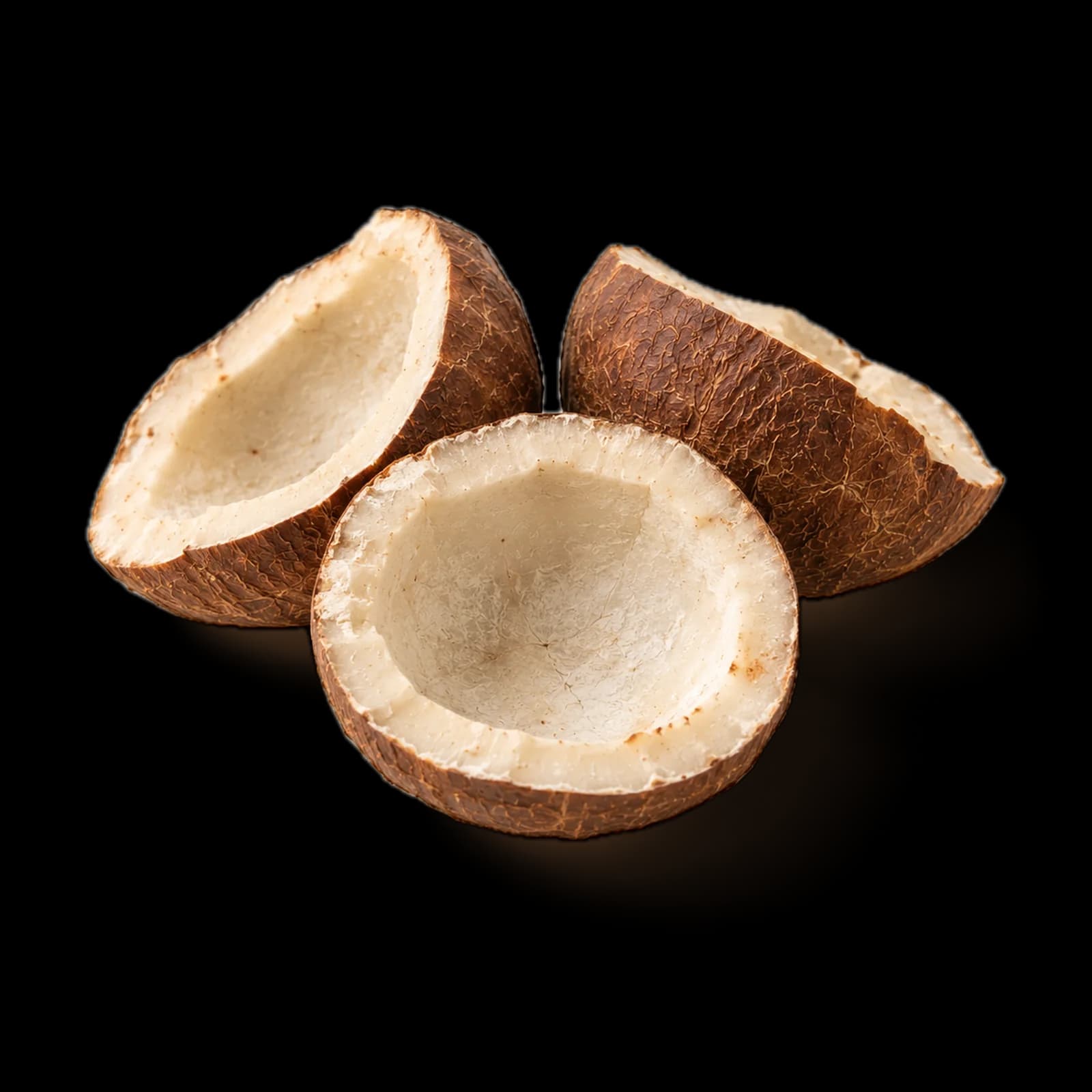 Dry Coconut Halves500 g ₹299 · 1 kg ₹549
More from the blog
Sources
- PIB: Cabinet approves Minimum Support Price for Copra for 2026 season (12 December 2025)
- Coconut Development Board: latest market prices for milling copra and ball copra
- AGMARK: grade designation and definitions of quality of ball copra for edible use
- AGMARK: grade designation and definitions of quality of cup copra for edible use
- Tamil Nadu Agricultural University: coconut harvest, post harvest, copra processing and grading
- International Coconut Community: quality standard for copra
- Coconut Development Board: coconut oil project profile
- Coconut Development Board: coconut products
- PIB: Cabinet approves MSP for copra for the 2024 season (27 December 2023)
- Directorate of Economics and Statistics: price policy for copra, 2018 season, with the CACP's recommendations