How to buy coco peat from India
Buy it by its specification: the grade, the EC and how it was measured, the moisture level, and how many blocks fit your container. Then test a 2 kg sample before you commit.
On this page
What is coco peat?
Coco peat, also sold as coir pith or coco coir, is the spongy material left when coir fibre is separated from a coconut husk. It holds several times its own weight in water and keeps air around roots, which is why it replaced peat moss in a lot of growing. India and Sri Lanka supply most of the world's traded volume, and in India most of it comes from Tamil Nadu and Kerala.
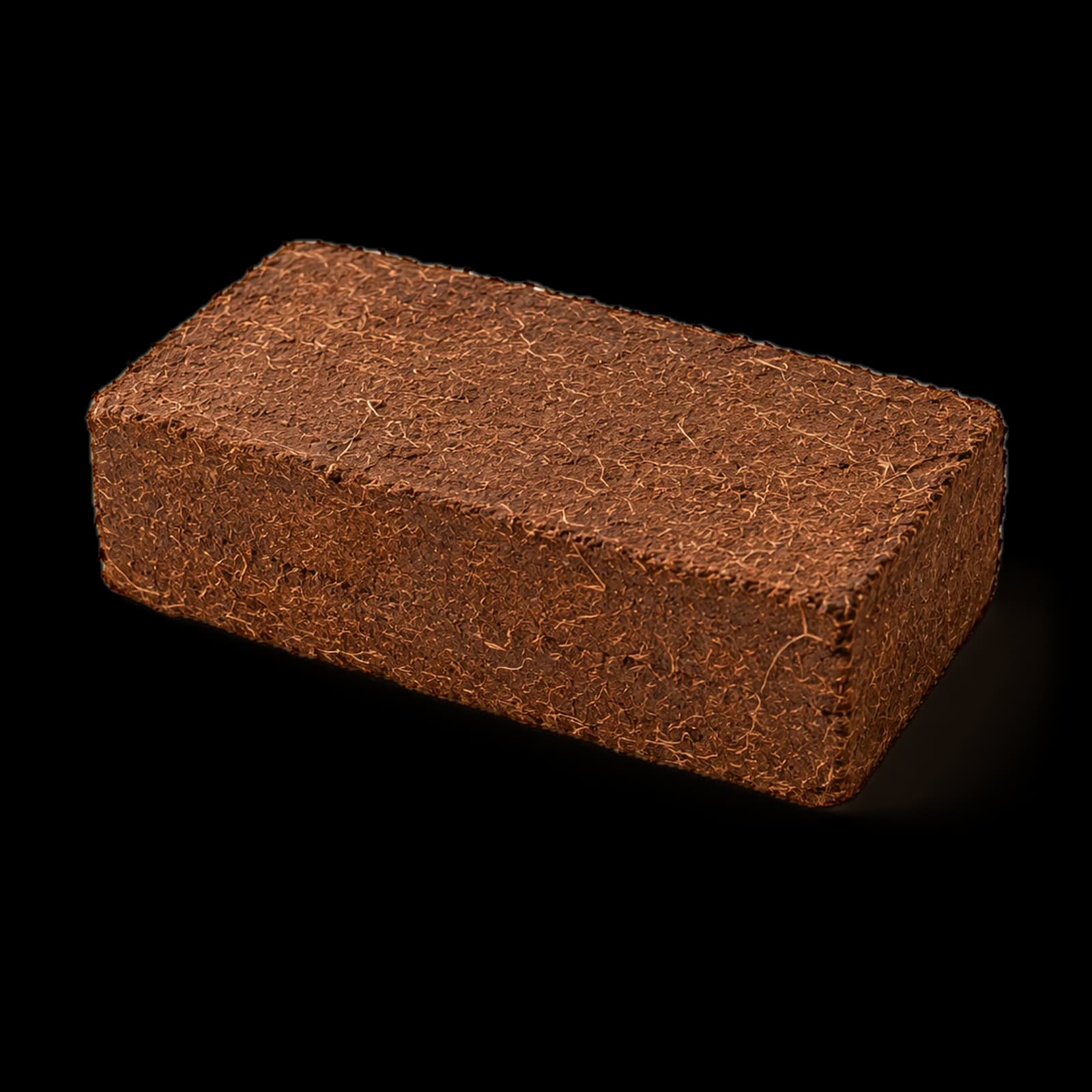
It travels compressed. The Coir Board's specification gives a 5 kg block as 30 by 30 by 13 cm, opening up to 13 to 14 litres a kilo, about 65 to 70 litres, once soaked. That is what makes it worth shipping across the world.
What EC should coco peat have?
Under 0.5 mS/cm for most growing, and under 0.3 for seedlings and sensitive crops. Raw pith reads 1.5 to 3.0, because coconut husk grows in coastal soil and holds sodium and potassium. Washing removes most of that salt.
Typical EC by grade, in mS/cm
Raw or unwashed
- Typical EC
- 1.5 to 3.0 mS/cm
- Where it is used
- Soil conditioning, land reclamation, industrial use
Washed
- Typical EC
- under 0.5 mS/cm
- Where it is used
- General growing, nursery media, potting mixes
Low EC washed
- Typical EC
- under 0.3 mS/cm
- Where it is used
- Sensitive crops, propagation, premium substrate blends
| Grade | Typical EC | Where it is used |
|---|---|---|
| Raw or unwashed | 1.5 to 3.0 mS/cm | Soil conditioning, land reclamation, industrial use |
| Washed | under 0.5 mS/cm | General growing, nursery media, potting mixes |
| Low EC washed | under 0.3 mS/cm | Sensitive crops, propagation, premium substrate blends |
Ask how it was measured
A 1:1.5 water extract and a saturated-media extract of the same coco peat differ by about two times, so an EC figure without its method can't be compared between suppliers.
Washed, buffered or raw: which do you need?
Washed coco peat is rinsed until its EC drops. Buffered coco peat is then soaked in a calcium solution, so calcium replaces the sodium and potassium held by the coir itself. Hydroponic growers need buffered. Soil conditioning does not.
- Washed: rinsed, usually in fresh water, until conductivity drops. It removes the salt that is loose in the material.
- Buffered: then soaked in a calcium solution, normally calcium nitrate, so calcium displaces the sodium and potassium bound to the coir. Washing alone doesn't remove those.
- Raw: untreated pith, cheaper per tonne, and fine where EC doesn't matter.
Buffering matters if you run a controlled feed. Unbuffered coir releases potassium into your solution and takes up the calcium and magnesium you just dosed. That shows up as a calcium deficiency that looks like a nutrient problem and is really a substrate problem. For open-field soil conditioning it is a cost you don't need.
What else is on the specification?
pH, moisture, fibre, sand and compression complete the sheet. Moisture deserves the most attention: at 20% moisture, a fifth of the weight you pay freight on is water, so a price per tonne means little until you know the moisture it was quoted at.
pH
- Typical range
- 5.5 to 6.8
- What it tells you
- Coir is mildly acidic and suits most crops without correction
Moisture
- Typical range
- up to 20%
- What it tells you
- You pay freight on water: a wetter block holds less product
Fibre
- Typical range
- 10 to 15%, or fibre-free
- What it tells you
- More fibre means more air space and faster drainage
Sand and silt
- Typical range
- under 2%
- What it tells you
- High silt means poor washing or dirty drying yards
Compression
- Typical range
- 5:1 typical
- What it tells you
- Sets the volume a block opens up to, and how hard it is to break up
| Property | Typical range | What it tells you |
|---|---|---|
| pH | 5.5 to 6.8 | Coir is mildly acidic and suits most crops without correction |
| Moisture | up to 20% | You pay freight on water: a wetter block holds less product |
| Fibre | 10 to 15%, or fibre-free | More fibre means more air space and faster drainage |
| Sand and silt | under 2% | High silt means poor washing or dirty drying yards |
| Compression | 5:1 typical | Sets the volume a block opens up to, and how hard it is to break up |
How many blocks fit in a container?
About 4,000 blocks of 5 kg, or 20 tonnes, in a 20 ft container, and about 5,300, or 26 to 27 tonnes, in a 40 ft high cube. Block density and the road weight limit at your end move these numbers.
5 kg blocks
- 20 ft container
- about 4,000 (20 t)
- 40 ft high cube
- about 5,300 (26 to 27 t)
650 g briquettes
- 20 ft container
- about 28,000
- 40 ft high cube
- about 40,000
Grow bags
- 20 ft container
- by specification
- 40 ft high cube
- by specification
| Format | 20 ft container | 40 ft high cube |
|---|---|---|
| 5 kg blocks | about 4,000 (20 t) | about 5,300 (26 to 27 t) |
| 650 g briquettes | about 28,000 | about 40,000 |
| Grow bags | by specification | by specification |
Block density varies between producers, so one yard's 5 kg block is not the same size as another's. Some destinations also cap the gross weight allowed on the road behind the port, so a container that loads legally in Cochin can be undeliverable at the other end. Confirm your road weight limit before you fix a quantity.
What should a first enquiry include?
A supplier can quote firmly from a short message that carries these details:
- 1.The grade: washed, low EC washed, buffered or raw
- 2.The EC and pH you need, and the method behind the EC figure
- 3.Format and size: 5 kg block, 650 g briquette, or grow bag size
- 4.Quantity, in blocks or containers rather than tonnes where you can
- 5.Destination port and the delivery term you work on (FOB, CFR or CIF)
- 6.Whether you need a third-party analysis certificate with the shipment
- 7.Your timeline, including any seasonal window you are buying for
What mistakes should you avoid?
- Comparing prices per tonne without comparing moisture: you may be buying water.
- Accepting an EC figure without asking which method produced it.
- Skipping the sample. A 2 kg sample costs a courier fee and tells you more than any specification sheet.
- Ordering buffered material where it isn't needed, or unbuffered material for a hydroponic system that needs it.
- Leaving fumigation and phytosanitary paperwork to the end. Some destinations need treatment certificates arranged before loading.
Questions buyers ask
What EC should coco peat be for hydroponics?
Under 0.5 mS/cm as a washed grade, and buffered with calcium if you run a controlled feed. Unbuffered coir swaps potassium into your feed and takes up calcium, which looks like a deficiency in the crop.
How many 5 kg blocks fit in a 40 ft container?
About 5,300 blocks, or 26 to 27 tonnes, depending on block density and the road weight limit at the destination. A 20 ft container holds about 4,000 blocks, or 20 tonnes.
What is the difference between washed and buffered coco peat?
Washing rinses out loose salt and brings the EC down. Buffering then swaps the sodium and potassium bound to the coir for calcium, which washing alone can't remove. Hydroponic growers generally need buffered coco peat; soil conditioning does not.
How much does coco peat expand?
The Coir Board's specification puts a 5 kg block at 13 to 14 litres a kilo, about 65 to 70 litres, once soaked and broken up. How much you get depends on how thoroughly the block is soaked.
Where can I buy coco peat from India?
Keraline Exports supplies coco peat from Kerala: a 650 g brick or a 5 kg block by courier anywhere in India, and full containers for importers.
Buying coco peat?
We supply coco peat from Kerala: a brick or a block by courier for pots and grow bags, and full containers for importers. Tell us the grade, EC and quantity, and we quote it.
 Coco Peat650 g brick ₹139 · 5 kg block ₹299